Your habit map
Each bar is one cancer, with the low, moderate and high bands shaded behind it. The dots below show which of your answers push it up. It isn’t a percentage chance.
What’s behind each result
After that
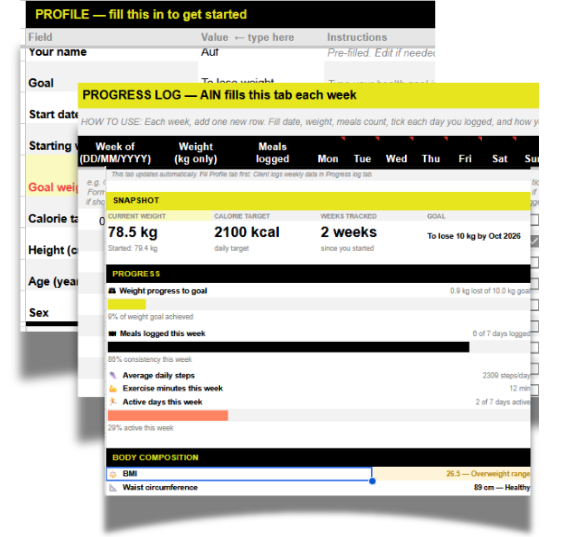
Turn this audit into a weekly habit
MyHealth Dashboard is a Google Sheets dashboard that does the same job as this audit, every week — weight tracking, meal consistency, and body composition (BMI, body fat, abdominal fat, and more). One-time price, no subscription.
- Auto-updating progress bars
- Body composition readings using the same method as CerminDiri
- Built-in links to MakanLah and MyTDEE
- Stays in your own Google Drive — I never see your data
No new app. No login. Just open it in Sheets and go.
Grab the Self-TrackerGo deeper
These Aufthority tools address the metabolic and cardiovascular risk that often runs alongside cancer risk.
Was this useful?
KanserCheck is free and built by one person. A small contribution keeps it free and funds new evidence-based tools for Malaysians.

Optional. Every tool stays free. More ways to support
Methodology & sources
This tool scores modifiable lifestyle risk factors against known cancer associations using IARC classifications and Malaysian population data. It is a lifestyle audit, not a clinical risk calculator. Signal tiers (Low / Moderate / High) are qualitative and do not represent absolute risk percentages. Scoring weights are ordinal representations of evidence strength, not quantitative risk estimates derived from hazard ratios.
Why BMI is not scored for breast cancer: The relationship between BMI and breast cancer risk in Malaysian and Asian women is actively contested and KanserCheck does not score what it cannot score confidently. The largest Malaysian breast cancer study (Tan et al., MyBrCA, n=7,663, PLOS ONE 2018) found higher BMI associated with reduced risk in Malaysian women. A larger 2024 prospective pooled analysis across East Asia (Asia Cohort Consortium, n=319,189, Japan/Korea/China) found BMI positively associated with breast cancer in both premenopausal and postmenopausal women — the opposite direction. South Asian data further complicates this by showing central obesity (waist-to-hip ratio) increases risk regardless of BMI. These findings cannot be reconciled into a single scoring rule. This unresolved gap is surfaced here rather than hidden, consistent with Aufthority’s evidence transparency standard.
Cancer incidence: MNCR 2017–2021, MOH Malaysia. Risk factor classification: IARC Monographs & IARC/Nature Medicine 2026. Alcohol & cancer: IARC dose-response meta-analysis. NPC: Chang et al., Cancer Epidemiol Biomarkers Prev 2021. Breast cancer: Tan et al., MyBrCA, PLOS ONE 2018 (n=7,663); Asia Cohort Consortium 2024 (n=319,189); northern Malaysia case-control 2011. Liver: Rosmawati et al. 2014; HBV seroprevalence, Sci Rep 2020; CodeBlue/Rosmawati fatty liver 2021. Cervical: Noor Mohamad et al. 2024. Colorectal: Malaysian dietary pattern case-control, PMC 2023; WCRF processed meat Group 1. NHMS 2024: IPH/MOH Malaysia. BMI thresholds: WHO Asia-Pacific 2000.
For informational purposes only. Not a medical or diagnostic tool. Consult a registered doctor or dietitian for personalised guidance.